The forehead is the area people ask for most and the one that most often produces the result nobody wanted: flat, heavy brows and eyes that look more tired than before. That outcome is a dosing decision, not bad luck.
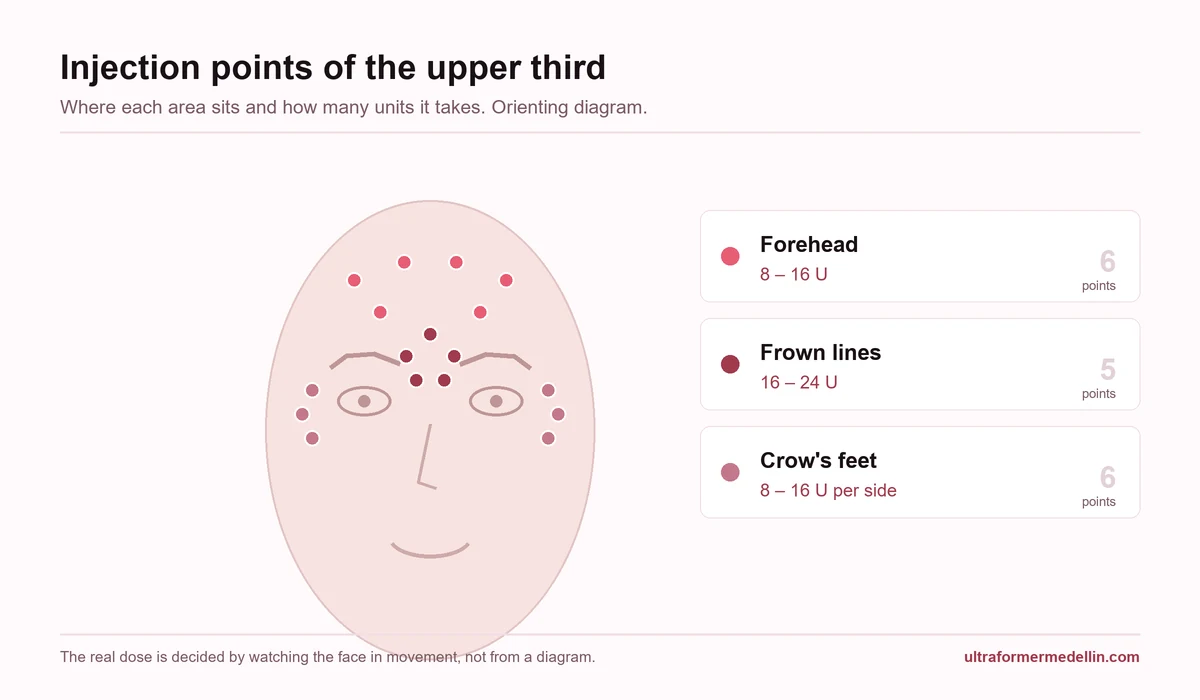
Why the forehead is dosed low on purpose
The frontalis is the only muscle that lifts the brow. Every other muscle around the eye pulls it down. Relax the frontalis too much and you have removed the only lifter, leaving the depressors unopposed — the brows sit lower, the upper lid looks heavier and the eye looks smaller.
That is the mechanism behind almost every complaint about forehead botox. It is not that the product was bad. It is that 8 to 16 units is the working range and someone used 25.
The practical consequence: a good forehead result keeps some movement. If your forehead cannot move at all, the dose was too high for your anatomy, and the fix is time — three to four months — rather than anything that can be injected.
Dose and injection points
8 to 16 units, distributed across four to eight points in the upper half of the frontalis, kept at least two centimetres above the brow. The lower third of the forehead is generally left alone precisely to preserve lift.
Two anatomical facts change the plan:
- Brow position at rest. If your brows already sit low or your upper lids are hooded, the forehead may not be treatable at all, or only at a token dose. This is checked before anything is applied.
- Whether the glabella is treated at the same time. Treating frown lines removes depressors and gives a small lift, which buys room for slightly more forehead relaxation. Treating the forehead alone does the opposite. This is why the two are so often done together.
What forehead botox costs
| Forehead | Price | Approx. USD |
|---|---|---|
| Forehead alone | $350,000 COP | USD 110 |
| Forehead + frown lines | $650,000 COP | USD 200 |
| Forehead + frown lines + crow’s feet | $850,000 COP | USD 265 |
The forehead is rarely the best value on its own — see the section above on why it is usually treated with the glabella.
Consultation is free and the 15-day review is included. The full rate for every area is on the price page.
When the line does not go away
Botox stops the fold happening. It does not erase a crease that is already etched into the dermis. The test is simple: relax your face completely in front of a mirror. Lines still visible at complete rest are structural, and toxin will soften them at best.
What actually helps those: time, because a line that stops being folded for a year does soften; or a different tool. Deep static forehead lines are a case for skin quality treatment rather than more units, and adding units to chase them is exactly how people end up frozen.
Frequently asked questions
Medical references
The clinical claims on this page rest on public, verifiable sources. They are cited so you can check them, not as an endorsement of this practice by those organisations.
- Aesthetic Surgery Journal (2025) — systematic review of HIFU in skin tightening and body contouring
- Lasers in Medical Science (2020) — systematic review and meta-analysis of HIFU safety and efficacy for face and neck
- American Academy of Dermatology — wrinkles and treatment options
- INVIMA — medical device registration in Colombia
Book a free consultation
We assess your brow position at rest before deciding a single unit for the forehead.
Message us on WhatsApp+57 316 042 2194 · Medellín, Medellín · English spoken
About who signs this content
Dr. Olga González — physician trained in Aesthetic Medicine (Universidad de San Martín), Health Coach in Nutrition, Longevity and Biohacking. She practises at Dra. Juventud, Medellín, Medellín, where she applies botulinum toxin (Botox® by Allergan and Dysport® by Ipsen) and treats skin laxity with Ultraformer MPT. Consultations are available in English.
Content last reviewed: September 1, 2026. This text is informational and does not replace an in-person medical assessment.