This is the single most useful number in the whole conversation, and the one most clinics leave out of a quote. If you only read one section, read the one on why «one zone» is meaningless without it.
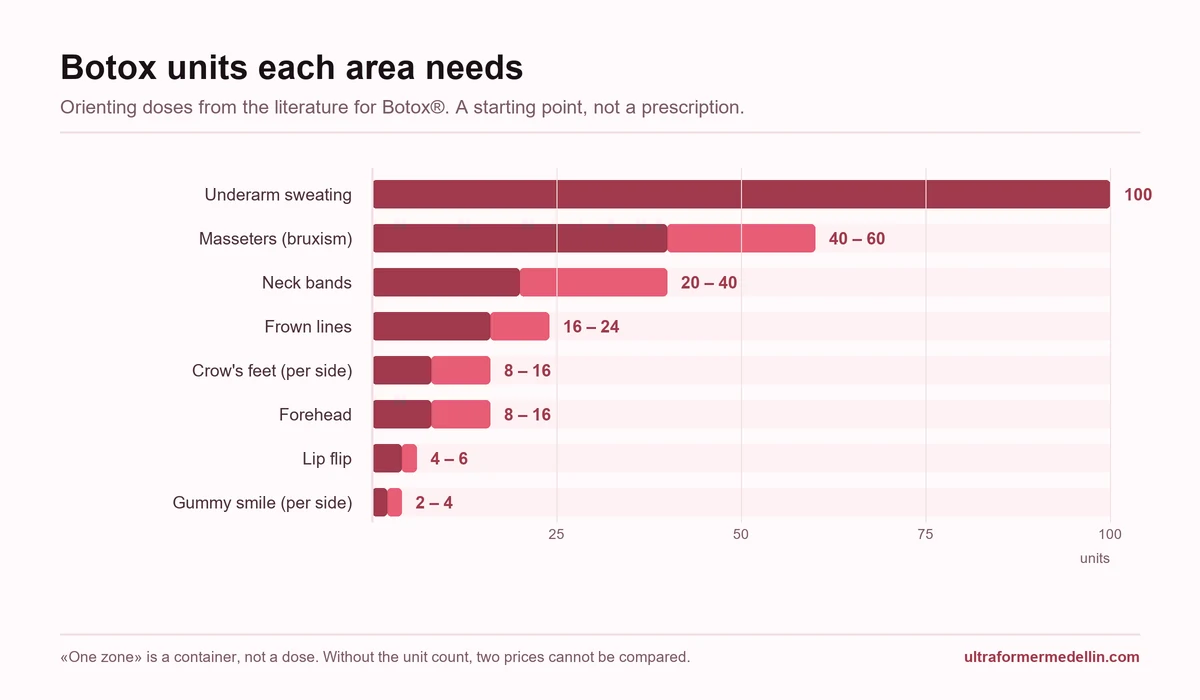
The dosing chart
These are the orienting doses from the literature for Botox® (onabotulinumtoxinA). They are a starting point, not a prescription: real dose depends on muscle strength, sex and goal, and men typically need more than women in the same area.
| Area | Typical units | Notes |
|---|---|---|
| Frown lines (glabella) | 16 – 24 U | The dose of the original FDA approval |
| Forehead (frontalis) | 8 – 16 U | Deliberately low: overdoing it drops the brows |
| Crow's feet | 8 – 16 U per side | Split across three points per side |
| Brow tail lift | 2 – 4 U per side | Small dose, large visual effect |
| Neck bands (Nefertiti) | 20 – 40 U | Depends how many bands there are |
| Masseters (jaw clenching) | 20 – 30 U per side | The area that consumes the most product |
| Gummy smile | 2 – 4 U per side | Minimal dose, narrow margin for error |
| Lip flip | 4 – 6 U | More than this affects speech and drinking |
| Chin (orange-peel) | 4 – 8 U | Mentalis muscle |
| Underarm sweating | 50 U per underarm | Product is the bulk of the price here |
Why the count decides the price
«One zone» is a container, not a dose. Two clinics can both quote «frown lines» and one apply 20 units and the other 8. The second charges less, the effect lasts half as long, and over a year the patient has paid more for a worse result.
So the comparison that works is not price against price. It is price divided by units applied. Ask any clinic for their total and the unit count, do the division, and put the result against a per-unit rate you trust.
At this practice the per-unit rate is $18,000 COP (about USD 5.60), and the packages work out to an equivalent of roughly $17,500, $16,200 and $14,200 per unit for one, two and three zones. The full breakdown is on the price page.
Units are not interchangeable between brands
A common and expensive misunderstanding: a «unit» of Dysport® is not equal to a unit of Botox®. The conversion is roughly two and a half to three Dysport units per Botox unit, which means a quote of «60 units» can describe either a large Botox dose or an ordinary Dysport one.
This is why a quote has to state the brand alongside the number. A count without a brand tells you nothing, and comparing two counts across different brands without converting tells you something actively wrong.
Both products are legitimate and both are used here. Dysport tends to spread a little more, which some practitioners prefer for the forehead and dislike near the eyes; Botox is the reference for the original glabellar indication.
Men need more, and it is not a surcharge
Male facial muscles are typically larger and stronger, and the dose required is higher — frequently one and a half times what the same area takes in a woman. That is physiology, not pricing policy.
It matters practically in two ways. A man treated at a standard female dose will often get a weak, short-lived result and conclude that botox does not work on him. And because the areas outside the three-zone packages are charged per unit, a higher dose does show up in the total — which is why the unit count is quoted in writing before anything is applied.
Frequently asked questions
Medical references
The clinical claims on this page rest on public, verifiable sources. They are cited so you can check them, not as an endorsement of this practice by those organisations.
- Aesthetic Surgery Journal (2025) — systematic review of HIFU in skin tightening and body contouring
- Lasers in Medical Science (2020) — systematic review and meta-analysis of HIFU safety and efficacy for face and neck
- American Academy of Dermatology — wrinkles and treatment options
- INVIMA — medical device registration in Colombia
Book a free consultation
In the consultation you are told your unit count before anything is applied.
Message us on WhatsApp+57 316 042 2194 · Medellín, Medellín · English spoken
About who signs this content
Dr. Olga González — physician trained in Aesthetic Medicine (Universidad de San Martín), Health Coach in Nutrition, Longevity and Biohacking. She practises at Dra. Juventud, Medellín, Medellín, where she applies botulinum toxin (Botox® by Allergan and Dysport® by Ipsen) and treats skin laxity with Ultraformer MPT. Consultations are available in English.
Content last reviewed: September 1, 2026. This text is informational and does not replace an in-person medical assessment.